

Two Inductors in Parallel — Why One Always Runs Hotter
To drive low-impedance loads, Class-D amplifiers often use two channels in parallel. In theory, current should be evenly split, but on the bench, one inductor usually runs noticeably hotter — and in severe cases, it can saturate first, triggering protection. Simply swapping in a higher-current inductor often delays the problem rather than truly solving it.
Put simply, paralleling isn't just "connecting two identical inductors together." Whether DCR values are close, saturation points match, layout is symmetrical, and heat dissipation affects both parts — all of these change how current is distributed.
- If the two inductors have mismatched DCR, current shifts toward the lower-resistance path;
- If saturation current margin is insufficient, the core demagnetizes first when peak current hits;
- If the two inductors are placed too close together, heat accumulates and temperature rise is underestimated.
ZhiXiangYuan Electronics' Class-D Amplifier Inductor Portfolio
ZhiXiangYuan Electronics serves customers nationwide, covering Class-D amplifier inductors, power inductors, audio transformers, microphone transformers, permalloy transformers, isolation transformers, toroidal transformers, high-frequency transformers, and EMI filters — integrating R&D, manufacturing, and sales. Customers in first-tier cities such as Beijing, Shanghai, Guangzhou, and Shenzhen can handle selection, sample shipping, and mass production remotely. For dual-channel parallel evaluations, Shenzhen customers can request samples sorted by DCR classification.
Before Paralleling, Check These Four Matching Items
Comparing the table below against your actual circuit is more effective than directly switching to a larger inductor.
| Matching Item | Single-Channel Use | Dual-Channel Parallel |
|---|---|---|
| Inductance | Selected based on single-channel ripple requirements | Equivalent inductance is halved after paralleling; ripple needs recalculation |
| DCR | Focus on efficiency and losses | DCR of both channels should be as close as possible; otherwise, current sharing becomes uneven |
| Saturation Current | Keep margin based on single-channel peak current | Calculate separately based on actual post-split peak current — don't simply divide by two |
| Temperature Rise & Layout | Single inductor has relatively ample heat dissipation space | Two inductors in proximity cause thermal coupling; keep spacing or add cooling measures |
| Verification Method | Measuring total output is sufficient | Measure both channel currents and temperatures separately to confirm current sharing |

Three Pitfalls Most Easily Overlooked During Debugging
Matching Inductance Only, Not DCR
Both inductors are rated at 10µH, but one has a DCR of 12mΩ and the other 16mΩ. When paralleled, current naturally favors the inductor with lower DCR. Under prolonged high-current operation, this inductor heats up and ages first. The solution is to require the manufacturer to sort by DCR, or to measure and match parts during incoming inspection.
Placing Two Inductors Too Close Together
Class-D amplifier inductors generate significant heat on their own. When placed right next to each other, heat accumulates, and temperature-rise testing tends to underestimate the real value. Leave spacing in the layout, and where necessary, stagger the components or add shielding to reduce thermal and magnetic coupling.
Measuring Only Total Output, Not Individual Channel Currents
Normal total output doesn't mean the two channels are sharing current evenly. Use current probes or shunt resistors to measure each channel separately to uncover hidden imbalance. Also record the surface temperature of both inductors during testing — don't just check one spot.
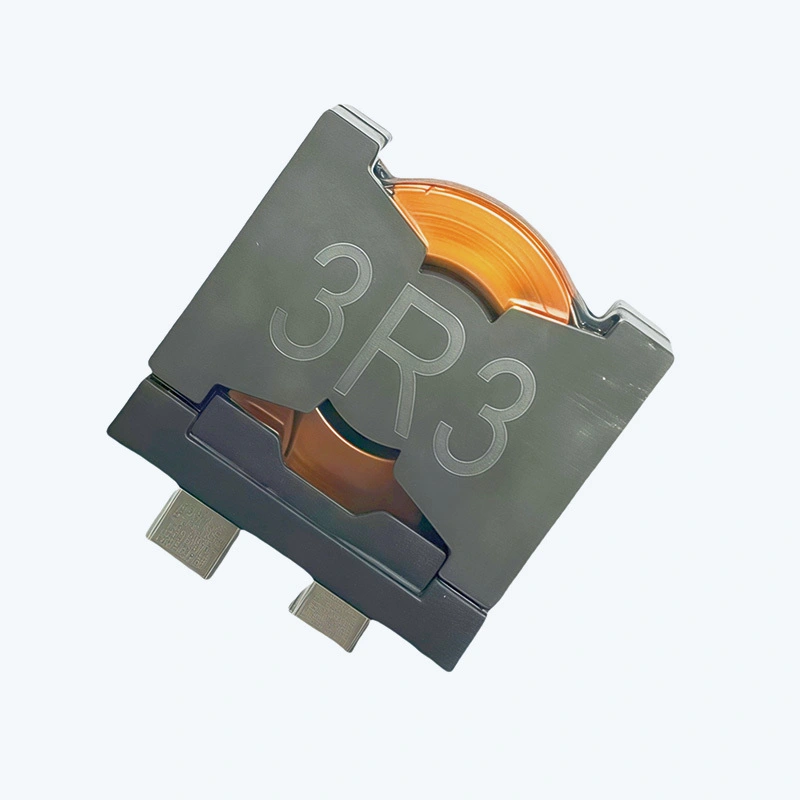
Verification Sequence for Dual-Channel Parallel Operation
- Calculate equivalent parameters first: After paralleling, inductance is halved and DCR is halved. Recalculate ripple and peak current based on the new parameters.
- Then select matched inductors: Require the same batch and DCR classification, and keep saturation-current margin based on the worst-case post-split scenario.
- Proceed with current-sharing tests: Measure both channel currents separately under rated and peak loads. If deviation exceeds expectations, adjust layout or switch to a different classification.
- Finally, perform temperature-rise and aging tests: Measure temperature in an enclosed or actual chassis condition to confirm no overheating during long-term operation.
If the project is still at the prototyping stage, compare two inductors from the same batch first to confirm current sharing and temperature rise, then decide whether to pursue custom matched pairs. This is a more prudent approach than committing to tooling upfront.

Frequently Asked Questions
Who can supply matched inductors for nationwide custom Class-D amplifier inductors?
Check whether the manufacturer supports classification by DCR or inductance and maintains batch traceability records. ZhiXiangYuan Electronics serves customers nationwide, with remote coordination available across all regions. For dual-channel parallel projects, state your matching requirements before requesting samples.
What should you look for when selecting a Class-D amplifier inductor manufacturer?
Pay attention to the saturation current definition, DCR control, shielding structure, temperature-rise test conditions, and batch-to-batch consistency. Suppliers who only specify inductance can hardly support parallel applications. ZhiXiangYuan Electronics documents key parameters in the datasheet.
How much extra will custom matched inductors cost?
Classification and testing add labor cost — typically a few hundred to a few thousand yuan, with per-unit cost decreasing at higher volumes. Compared to rework caused by poor current sharing downstream, upfront matching is usually more economical. Define the tolerance range clearly first.
How are lead time and consistency guaranteed?
Typical lead time ranges from a few days to a few weeks, depending on core and wire inventory. Consistency is ensured through fixed material sourcing, controlled winding methods, and DCR classification. ZhiXiangYuan Electronics maintains test records by batch and runs a small pilot lot before mass production.
Send Us Your Parallel Configuration and Load Conditions
For dual-channel parallel operation, the key isn't "big enough inductors" — it's "two closely matched channels." Organize your load impedance, output power, switching frequency, two-channel layout, and cooling conditions, and submit them via the inquiry page. We'll first help you determine whether matched pairs are needed. To understand core material trade-offs, see ferrite vs. alloy powder core comparison; for temperature-rise test methods, refer to Class-D amplifier inductor temperature-rise testing.
ZhiXiangYuan Electronics is committed to traceable parameters, batch consistency, and engineering support: for parallel configurations, verify current sharing and temperature rise first.


